COLLABORATIVE
RESEARCH
Long COVID is driven by multiple disease drivers, resulting in a range of clinical phenotypes.
Key research targets:
Validated biomarkers for phenotypic stratification.
Diagnostic methods with companion therapeutics suitable for clinical use.
Large-scale trials with highly selective inclusion criteria.
A collaborative research infrastructure with cutting-edge technologies could usher in an era where…
Antivirals, immunotherapies, and related therapeutics become treatment possibilities for millions across the world.
Viruses are increasingly implicated in a growing number of chronic conditions including ME/CFS, multiple sclerosis, Parkinson’s and Alzheimer’s disease. Persistent viral or bacterial activity may even play a role in the human aging process.
The path to curing Long COVID may yield therapeutic benefits for multiple conditions.
Below are some of the current collaborative research initiatives.
Long COVID Research Consortium
A collaboration of scientists from 25+ global institutions working to study and treat Long COVID. Click here
Harvard Medical School, Yale University, Institut Pasteur,
University of California San Francisco, J. Craig Venter Institute,
Johns Hopkins University, Cardiff University, University of
Pennsylvania, Icahn School of Medicine at Mount Sinai,
Stellenbosch University, Université Paris Descartes, Berkeley
Joint Genome Institute, University of Colorado, UMassChan
Medical School, George Mason University, Karolinska Institute
Research Priorities
The Long COVID Research Consortium program spans the following topics:
1) SARS-CoV-2 Persistence
Research studies are investigating whether SARS-CoV-2 can persist in tissue reservoirs long after the acute infection has resolved. Scientists are studying how persistent viral RNA or proteins in tissues such as the gut, lymph nodes, nervous system, and blood vessels may continue to provoke immune activation and drive chronic symptoms.
2) Co-Infections and Microbiome Imbalance
Studies suggest that Long COVID may involve reactivation of latent pathogens such as Epstein-Barr virus (EBV), Bartonella, and other chronic infections. Researchers are also investigating how disruption of the gut microbiome and oral microbiome may contribute to immune dysfunction, inflammation, and impaired recovery.
3) Neuroinflammation and Neuroimmune Dysfunction
Scientists are investigating how chronic immune activation may impact the brain and nervous system in Long COVID patients. Research is using multiple forms of advanced PET scanning and other imaging technologies to examine mechanisms including neuroinflammation, autonomic nervous system dysfunction, and abnormalities in immune signaling that may contribute to symptoms such as brain fog, fatigue, sleep disruption, and sensory hypersensitivity.
4) Blood Vessel and Endovascular Dysfunction
Research studies are identifying abnormalities in blood vessels and circulation that may impair oxygen delivery and tissue function in Long COVID. Current projects are investigating platelet activation, neutrophil activation, endothelial dysfunction, fibrin amyloid microclots, and inflammatory damage to the vascular system.
5) Mitochondrial and Metabolic Dysfunction
Scientists are investigating whether Long COVID disrupts the ability of cells to properly generate and utilize energy. Research is examining mitochondrial dysfunction, altered cellular metabolism, oxidative stress, and impaired oxygen utilization as potential contributors to profound fatigue, exercise intolerance, and post-exertional symptom worsening.
Spring 2026 PolyBio Symposium
Friday May 22nd: PolyBio-supported researchers and collaborators presented updates on their projects.
Watch the presentation recordings or use the interactive platform to read full research summaries.
Cutting-Edge Technologies
These projects push the boundaries of how cutting-edge technologies can be used in the study of chronic disease.
Spatial transcriptomics that allow for a detailed understanding of immune activity near identified virus.
Whole-body PET imaging technologies that allow for visualisation of SARS-CoV-2 in deep tissue reservoirs.
Single nuclei RNA sequencing to characterise the landscape of tissue, blood vessel, and nervous system changes.
VIPER - Diagnostics Programme
VIPER is a next-generation Long COVID diagnostics program designed to validate assays by comparing tissue-based measurements of disease to those present in accessible fluids like blood.
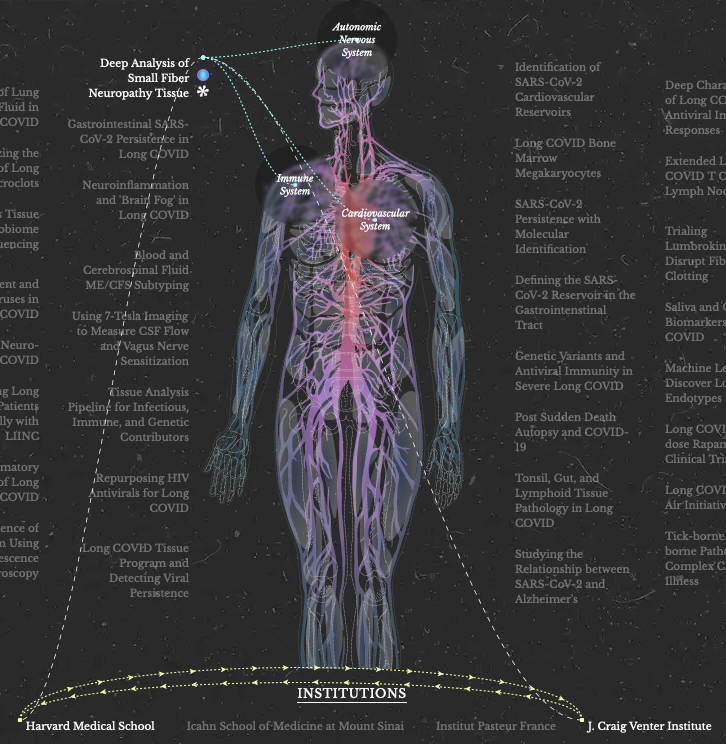
PolyBio Consortium Project Explorer
This interactive module provides an overview of the PolyBio Consortium’s research, therapeutic projects, technologies, and key findings across international institutions. It identifies primary research sites and, where applicable, institutions involved in sample sharing.
International Society for Long COVID and Post-Acute Infection Syndromes
ISLC-PAIS Conference 26 – 29 August, 2026 Amsterdam (the Netherlands)
The International Society for Long COVID and Post-Acute Infection Syndromes (ISLC-PAIS) is an independent, global coalition of clinicians, scientists, public-health experts, people with lived experience, and advocates working to protect health through evidence-based policy, transparent science and ethical medical leadership.
Post-Acute Infection Syndromes (PAIS), including Long COVID, are among the most complex and urgent health challenges of our time. Their impact extends far beyond healthcare, affecting work, education, social participation and long-term wellbeing, with growing economic consequences. Despite rapidly growing scientific insight, knowledge remains fragmented across disciplines, countries and care systems. This underscores the need for structured international collaboration to integrate evidence, align clinical practice and accelerate real-world impact.
ME/CFS RESEARCH FOUNDATION
We are committed to more biomedical ME/CFS research (incl. post-COVID). Our focus is on diagnostics and therapy research. In this way, we also promote medical awareness and care for those affected. We are a team of patients, relatives and committed supporters.